Talent Is Overrated: What Really Separates World-Class Performers From EverybodyElse by Geoff Colvin
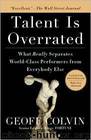
Author:Geoff Colvin
Language: eng
Format: mobi
Tags: Industrial & Organizational Psychology, Human Resources & Personnel Management, Psychology, Work, General, Careers, Self-Help, Performance, Personal Growth, Psychological Aspects, Work - Psychological aspects, Business & Economics
ISBN: 9781591842941
Publisher: Penguin
Published: 2009-01-02T00:00:00+00:00
Chapter Seven - Applying the Principles in Our Lives
The opportunities are many - if we think about our work in a new way.
Benjamin Franklin was "America's first great man of letters" in the view of David Hume and many others, so we might naturally wonder how he came to be the extraordinary writer he was. His own account of it in his autobiography is well known—most of us read it in school—but in light of what we now know about how great performers develop, several elements of the story seem more significant and instructive than we may have realized.
As a teenager, Franklin seemed to think he wrote well enough, but then one day his father found an exchange of letters between Ben and a friend, John Collins, arguing a point back and forth. (The argument was whether women should be educated, Collins contending they were naturally unable to learn as much as men, Franklin taking the other side.) Ben's father first told his son what was good about his letters; they were better than Collins's in spelling and punctuation. Then he told him and showed him specifically how they were inferior: "in elegance of expression, in method and in perspicuity, of which he con vinced me by several instances," as Franklin recalled. We must note in passing that when it comes to giving people evaluations—offering praise first, then supporting criticisms with examples—old Josiah Franklin could be a model for us all.
Ben responded to his father's observations in several ways. First, he found examples of prose clearly superior to anything he could produce, a bound volume of the Spectator, the great English periodical written by Joseph Addison and Richard Steele. Any of us might have done something similar. But Franklin then embarked on a remarkable pro gram that few of us would ever have thought of.
It began with his reading a Spectator article and making brief notes on the meaning of each sentence; a few days later he would take up the notes and try to express the meaning of each sentence in his own words. When done, he compared his essay with the original, "discovered some of my faults, and corrected them."
One of the faults he noticed was his poor vocabulary. What could he do about that? He realized that writing poetry required an extensive "stock of words" because he might need to express any given meaning in many different ways depending on the demands of rhyme or meter. So he would rewrite Spectator essays in verse. Then, after he had for gotten them, he would take his versified essays and rewrite them in prose, again comparing his efforts with the original.
Franklin realized also that a key element of a good essay is its organization, so he developed a method to work on that. He would again make short notes on each sentence in an essay, but would write each note on a separate slip of paper. He would then mix up the notes and set them aside for weeks, until he had forgotten the essay.
Download
This site does not store any files on its server. We only index and link to content provided by other sites. Please contact the content providers to delete copyright contents if any and email us, we'll remove relevant links or contents immediately.
The Brazilian Economy since the Great Financial Crisis of 20072008 by Philip Arestis Carolina Troncoso Baltar & Daniela Magalhães Prates(304950)
International Integration of the Brazilian Economy by Elias C. Grivoyannis(111313)
The Art of Coaching by Elena Aguilar(53416)
Flexible Working by Dale Gemma;(23319)
How to Stop Living Paycheck to Paycheck by Avery Breyer(19779)
Thinking, Fast and Slow by Kahneman Daniel(12416)
The Acquirer's Multiple: How the Billionaire Contrarians of Deep Value Beat the Market by Tobias Carlisle(12378)
The Radium Girls by Kate Moore(12090)
The Art of Thinking Clearly by Rolf Dobelli(10598)
Hit Refresh by Satya Nadella(9185)
The Compound Effect by Darren Hardy(9055)
Tools of Titans by Timothy Ferriss(8490)
Atomic Habits: Tiny Changes, Remarkable Results by James Clear(8406)
Turbulence by E. J. Noyes(8113)
A Court of Wings and Ruin by Sarah J. Maas(7944)
Change Your Questions, Change Your Life by Marilee Adams(7847)
Nudge - Improving Decisions about Health, Wealth, and Happiness by Thaler Sunstein(7758)
How to Be a Bawse: A Guide to Conquering Life by Lilly Singh(7545)
Win Bigly by Scott Adams(7256)
